A List- a simple list can be the gateway to something grander.
Let’s start with your shopping list. I write mine in the order that I move through the shop. When I first walk in the fruit and veg is right in front of me, so that’s what my shopping list would start with…
How do you write your shopping list? Do you write it or do you wing it? I know this may seem mundane, everyday or even *gulp* ordinary but the ordinary stuff is important – rituals, routines, habits that ground us.
So let’s pick something from my list. I’m going to focus on potatoes. Now, I love potatoes, don’t you? I hate sweet potatoes. I’m talking about white potatoes. The little baby ones we buy every week without fail.
So now I’m going to write another list- a list of describing words for potatoes.
Eyes have caught my attention to be honest. A long time ago, I spent a 6 hour unwaged trial shift in a café in Napier in New Zealand.
My quest: to prove I was worthy of a job.
My job: to remove the eyes from old potatoes.
I failed my quest but this isn’t the story I am ready to tell. So I’m gonna leave that memory for another day…
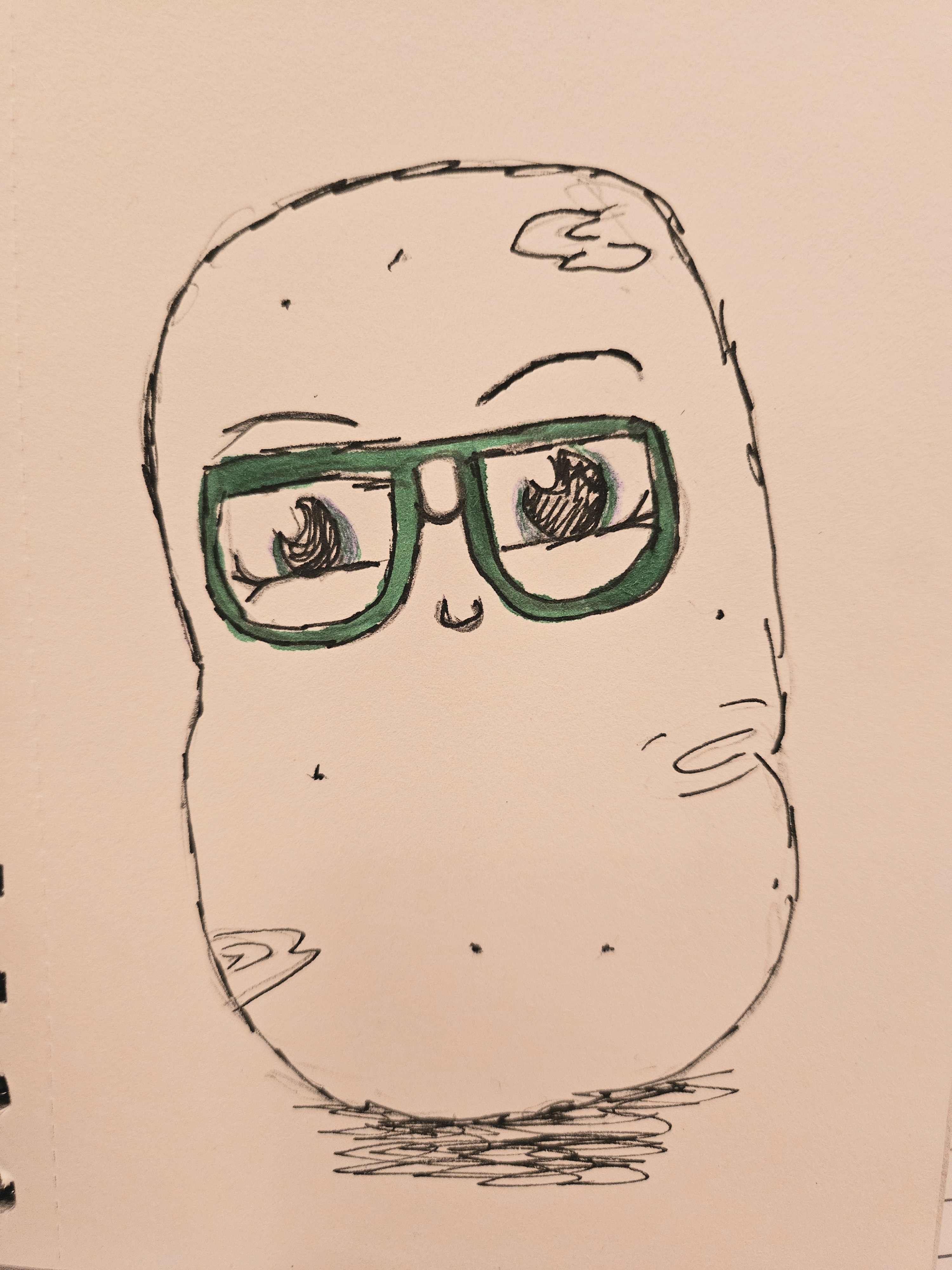
Eyes caught my attention because it made me think what if potatoes had actual eyes. Not weird growths but actual eyes. What colour would they be? If they grow underground, do they even need eyes? Do they need glasses when they drive? Hang on, my questions have started to step off to the fantastical. So you could try writing some questions too. You could start with 10 – allow memories to run, use what ifs to conjure the fantastical. If it feels silly, good! What’s wrong with that anyway?
So in simple terms
Write list 1
Pick something off list 1 and write another list of describing words.
Ask some questions about this item?
Enjoy yourself!
Don’t worry about absurdity or whether or not the questions can be answered.
Don’t worry about your handwriting or your spelling or your grammar.
Don’t worry if it’s good or not.
You’ve just started.
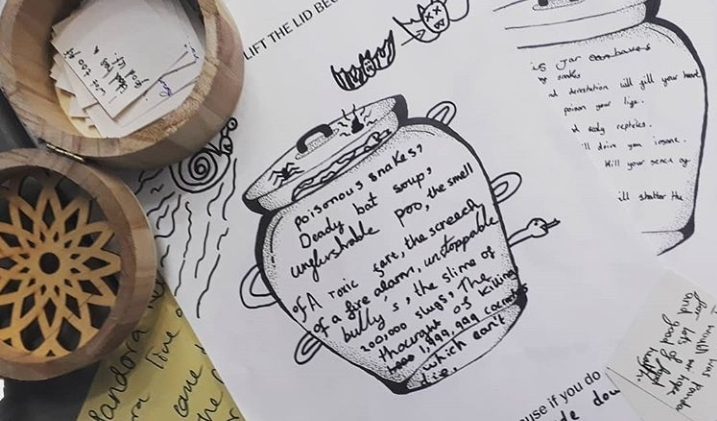
And if you are wondering about a potato with eyes still, I offer my humble drawing…
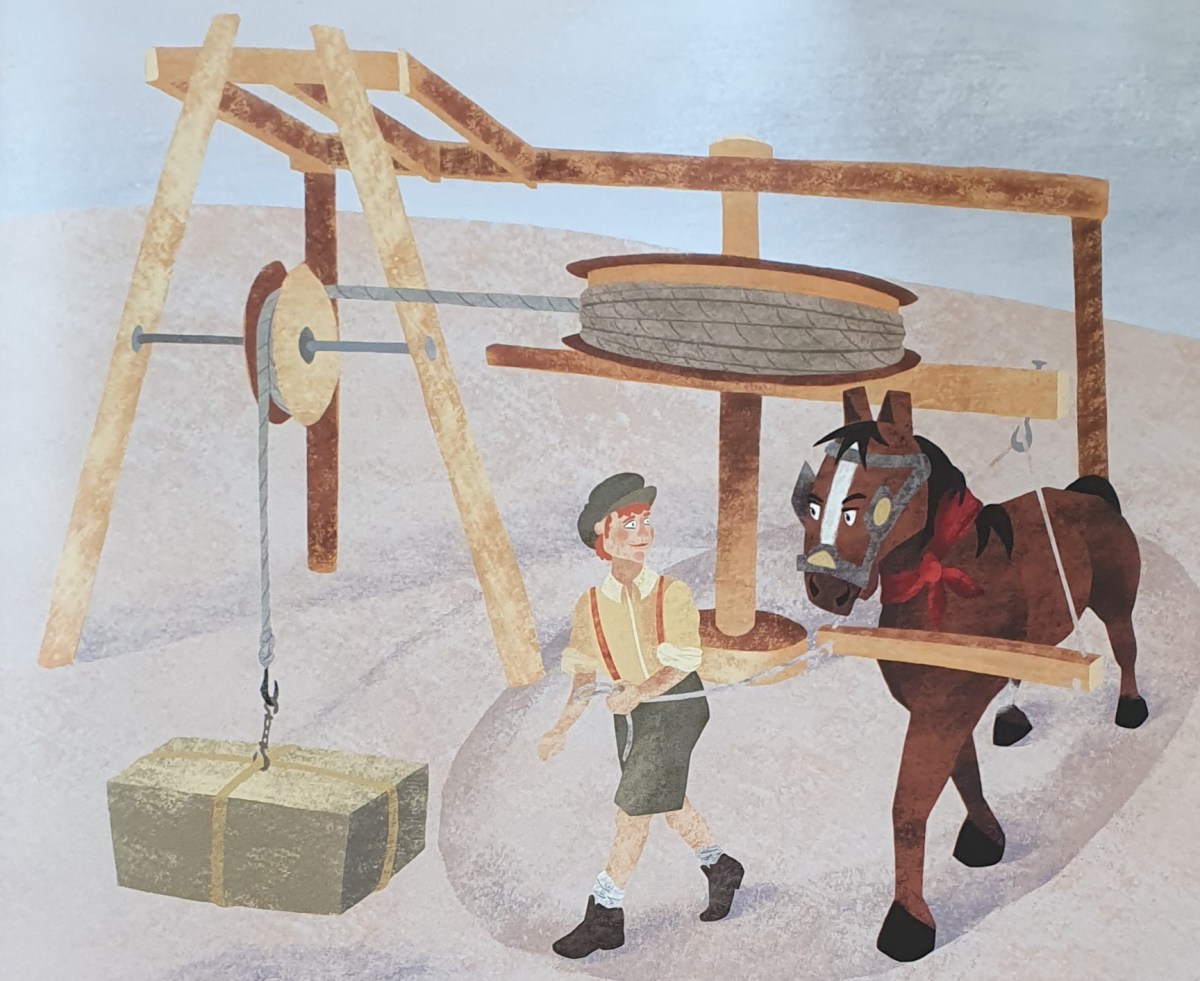
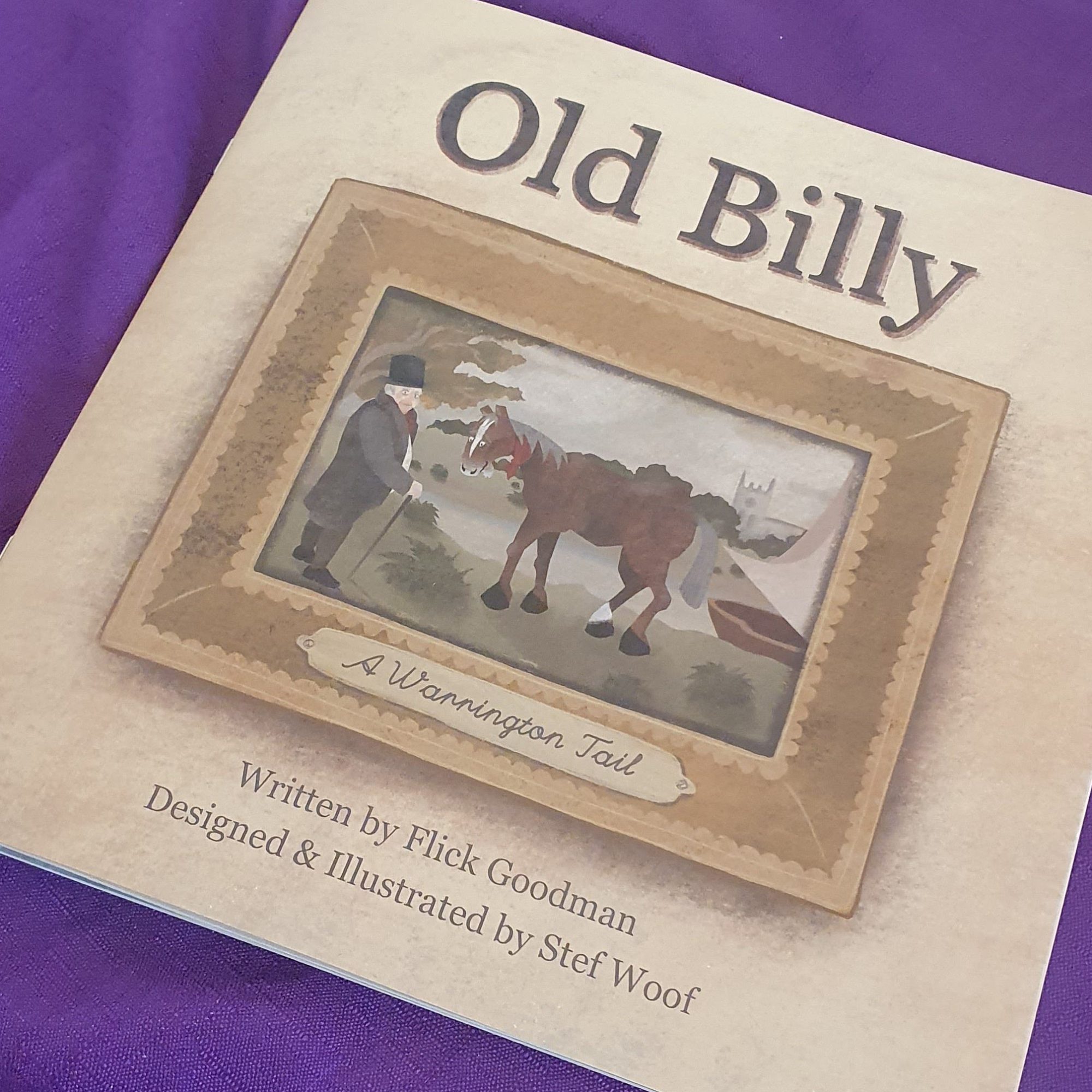
Written by Flick Goodman, Illustrated by Stef Woof and Published by Culture Warrington
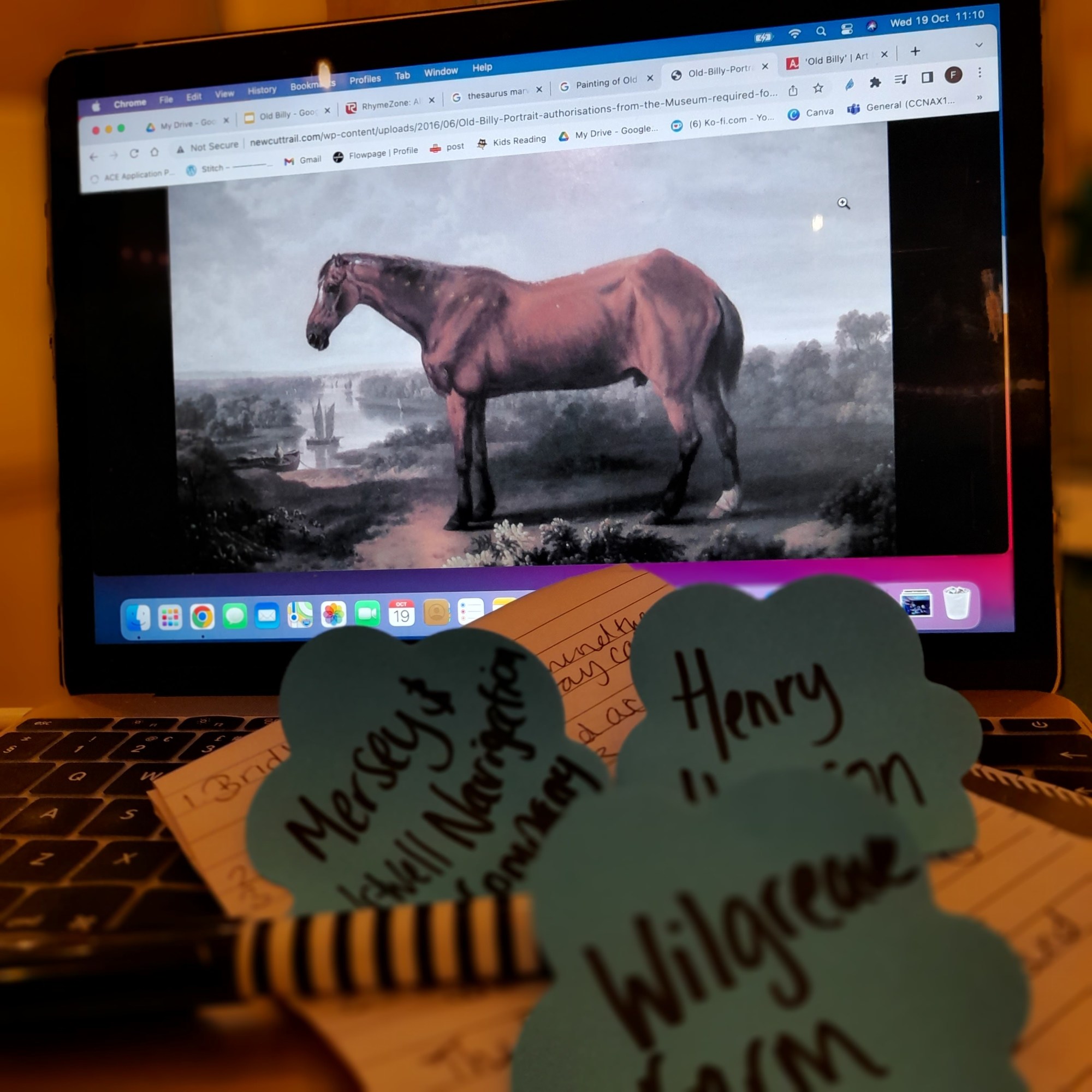
Old Billy is one of the great figures of Warrington history. Billy was born at Wilgreave Farm in Woolston in 1760 and died at Old Warps in Latchford in 1822. Old Billy is claimed by many people to have been the World’s oldest ever horse.
Working with the archives team at Culture Warrington, I wrote a ballad style poem inspired by the way that communities told stories during the Industrial Revolution. The words were then handed to Stef Woof, who beautifully illustrated the story.
Copies of the book can be purchased from Warrington Museum or borrowed from one of Warrington’s libraries. You can learn more about the life of Old Billy on the museum’s website
Old Billy Workshop
Inspired by Culture Warrington’s Old Billy, A Warrington Tail (Written by Flick Goodman and Illustrated by Stef Woof), this workshop will have children creating their own ballad inspired by the characters found in the pages of picture book. We’ll share facts from the Industrial Revolution along the River Mersey and find out why ballads were so important. Please get in touch, if you would like to find out more about this workshop.
Turning All Day by Flick Goodman and Year 2 Bewsey Lodge Primary School
Sometimes when you are looking for a story, you can’t find it and yet you can see the need for one everywhere you look.
I have a autistic daughter. The journey to understanding and supporting her has been relentless and remains ongoing. We are lucky she attends a brilliant school with an extremely humble, caring and conscientious SENDCo. Like many families with a SEND child, it has been hard and we have experienced the underfunding that everyone is talking about through a lack of provision of health services and the arms length distance we are held at when it comes to getting practical support and advice.
If you have slipped on the stairs, whilst holding your baby, you body reflexes take over. You pull the baby in close shielding them from the fall with your body as you back takes the bumps, the scratches, the carpet burn and the awful twists. That’s what this feels like. but where the fall is over in seconds, this goes on for years.
I have written this story to share a tiny window into our world. It’s always hard to share personal information about yourself, especially when it comes to your children.
I hope that it builds better empathy to those who created the complex systems that we have to navigate for our children to have experiences in life that are meaningful and bring joy.
I hope that it brings comfort and recognition to parents going through similar experiences and I hope that you know, that no matter how lonely or futile things can seem, you and your children matter. I’m going to keep telling myself that anyway.
The Selkie’s Child can see that her mother is fading. She knows that she must free her.
What the hardest choice you have had to make?
When you father steals your mother’s seal skin, and you know the right thing is to let her go. The Selkie’s child comes to her mother and pledges to help her find her seal skin, even if it means losing her mother to the sea.
If you could build a better world what would it look like?
Gretel wants to live in a better world. She dreams of her perfect place -a Utopia to hope for. This piece of spoken word incorporating song, was inspired by ideas gathered in workshops gather with children and their families over 2022.
A Utopian world building workshop is available to book exploring children’s identity and values and Fantasy and Science Fiction Genres. You can read more about workshops here.
Informed by ideas gathered in workshops with young people and children, Red: A Dystopian Fairy Tale is a spoken word piece about an imagined futuristic world ruled by a totalitarian regime known as Mother.
A world building workshop is available to book exploring Dystopian fiction. You can read more about workshops here.
The world always changes. Even in ways that may not always be visible to us and if we let ourselves, then we change too. Sometimes other people hold us back and at other times we may let them. Some stories survive all those changes and serve us. They deepen our understanding of the way we experience the world, even if we live in a different time and place entirely. Those stories belong to us all and the way we tell them tells us something about the teller themselves. So here is an offering, in this time of transformation, to hopefully help make sense of this jumbled world.
You already know this story.
A lonely man, they always are.
He found it hard to connect to others and yet he could see their joy within their families and that their hearts were full and he wanted that. He saw their heads thrown back in laughter and when out walking the weather beaten coastal paths at dusk, the warm glow of a well attended hearth spilled out of small cottage windows, and he wanted that.
In the village, he witnessed lovers walking hand in hand, eyes missing the surrounding gray world, lost deeply to each other and the promises of the happy lives they were going to have together. And he wanted that.
But time passed and as he stitched the torn nets of local fishermen, he never made a catch. With each stitch into each net his heart shrunk, his gut grew and the lines of loneliness and frustration deepened. He had never been small, even as a boy, but now he was broad and tall – a hulking mass of a man. And as he swelled the women in the village were lost to him and carried into calmer waters on a more comfortable boat. They didn’t want him.
So the man grew solitary and short tempered, his language coarse with under use and his voice carried a bark- the kind you’d hear in an agitated dog.
One evening, as the sun slipped below the surface of the sea and the moon swelled like an empty, expectant plate, the man took a turn off his usual clifftop path and carefully picked his way over the rocks that were always shifting in the cliff face. He descended down towards the smaller smooth stones that washed up on the shoreline.
He starred out to sea – what was the point of a man so lonely? He pulled off his boots and decided he would swim till he could swim no more. Until he would slip silently beneath the waves. And this resolve, this feeling of holding a destination in his mind, this decision lifted his eyes. What a beautiful place to die. His skin felt the wind blowing through his threadbare unpatched clothes. He tasted the salt heavy in the air and he heard the wind singing. Or did he? Amongst the whistling wind, he heard laughter and shouts and multiple voices. He wasn’t alone, somewhere nearby was a group of people. He turned towards the voices and understood that they were coming from a small inlet surrounded by rocks – a perfect place, protected from the elements. He walked over and not wanting to be seen he crawled the final section and peered through the cracks in the rocks.
A group of naked women were laughing. Their white skin seemed to glow in the moonlight, like they had a bright and brilliant light within them. The man was filled with longing, his mind turned to his empty house, his empty life, his empty heart. What life he could have if his house could be filled with such radiance. How freely these women danced and sang and swam. He quietly climbed higher to get a better look, keen to not get caught.
That is when he saw the skins – silver blotted with darker patches. They were all an arms length away from him. Seal skins. He counted them. One, two, three, four, five, six, seven. He counted the women – One, two, three, four, five, six, seven. These women had not arrived on foot over land. They had come from the sea and shed their velvety skin to dance upon the sands freely under a full moon. His longing turned from want to need to must have. He was going to have one, just one, of those women, just one of those magical selkie women would be enough. He reached out and with thick fingers grabbed the nearest skin. It felt soft and thick like a scarf hugging your neck or a sleeping kitten. He pulled himself back to his hiding place behind the rocks and stuffed the skin under his jumper. He waited wondering which woman would belong to him.
One by one, the women returned to their skins, a gray dawn was arriving over the cliftops. It was time to return home to the sea. They pulled on their skins and slipped into the incoming tide, till only one woman remained. She searched but could not find her skin. She called to her sisters to help her but they had disappeared beneath the waves. She called and searched and called and searched until her heart grew weary and the man watched and watched, waiting for the moment when her hope would disappear.
Soon enough, the woman gave up. She sank down to the rock beneath her, hugging her knees to her chest.
The man stepped out from his hiding place.
‘I have your skin.’ he said.
The selkie woman shivered from the cold, the exposure, from the man that towered over her.
‘Come with me.’ he said. ‘I can give you a good life.’
‘I have a good life.’ she replied. ‘Swimming with my sisters. Please give me back my skin.’
The man’s longing burned. He thought how much better his life would be for having her in it.
‘Stay with me, for 7 years. For 7 years be my wife. After those seven years have passed, I will return your skin to you. The woman thought what else could she do but accept his offer. She could not return to the sea without her skin to protect her and she could not fight a man so large. What was 7 years in a life that could stretch to 100. She agreed. The man greedily snatched her up. He set her on her feet and helped her down from the rocks. He took off his coat and wrapped it around her shoulders.
The coat felt strange – coarse against her skin and the smell was odd like smoke, but what does a woman of the sea know of fire? She followed him as he led her back up off the beach and up the cliff and along the path to his village by the harbour. And there in a tumbledown cottage they made a life and the man softened, although those years of jagged loneliness could never really be smoothed.
She wore the dresses he bought her and looked like a normal wife despite not knowing the ways of a kitchen. Her belly soon swelled and carried out into the world, on a tide of fear, a child was born. A girl. The child was human. She bore no sign of being Selkie. Now the woman was tied to land in a way that was larger than the deal struck on the beach.
Seven years passed. The girl was fed on stories of sea caves and creatures. She was hushed to sleep with the songs of whales and seaweed and water. The child grew well. Rosy skinned and full bodied in fine fettle. The woman waned. Her skin became dryer and dryer until it cracked and her eyes suffered. The world turned into colour and indistinguishable shapes. The woman loved her child, but the longing to be back in the sea with her own kind was causing her body to shut down.
As the seventh year drew to a close, she turned to the man and asked for her skin to be returned to her. The girl, whose parents thought she was asleep, heard the conversation between her parents.
‘7 years have passed. It is time for my skin to be returned to me.’ said the woman.
The man’s fear of being alone reared its ugly head. Left with a young girl to raise without a woman to guide her in things he did not know or understand.
‘I cannot give your skin back to you.’ he said.’ I cannot lose you to the sea.I cannot once again be alone.’
‘You will lose me, with or without returning my skin. I cannot survive here. I am fading fast. To keep me here is to kill me.’
‘What of your child? Do you not love her?’
‘ I love her with all of my body, but my body is weak and I cannot be there for her in death.’
The man shook his head. ‘You belong to me. You are mine and mine alone. I will not give you your skin. Filled with darkness, the man left the house. The woman silently mourned the fight she didn’t have 7 years earlier, now too weak, 7 years on to fight.
The girl having heard all of the exchange was horrified. She didn’t want her mother to die. For days her thoughts swilled a round and a round in her head. What could she do? How could she save her mother?
Meanwhile the woman became extremely frail. Her skin was carved up into patterns like contours and borders on a map. Her sight reduced to near blackness. Her heart, already weakened from the years out of the water, out of her skin and away from home, beat like a fading drum.
The girl drank it all in, She saw her fathers impatience and his snap at this sad, frail woman that he now had for a wife. She saw her mother shrinking and despite being young in years, she knew that her mother was dying.
One full mooned night, while the girl sat drinking in the blackness of the night and the blackness of her thoughts she heard a song on the wind. Her small bedroom rattled as the song found its way through the grains of wood holding the pane of glass in place.
She quietly tip-toed down the stairs on soft slippered feet and made her way to the front door. After Pulling on her woollen hat and mittens and sheepskin lined coat she stepped out into the night. The song was louder out in the harbour. The wind blew from the north west along the coastal path . she followed the sound as she followed the song became louder and the girl grew in confidence, knowing that each step along the path meant discovering answers. Down onto the beach that had been the meeting place for her parents, 7 years earlier. She stopped and looked out to the sea where her mother came from. She felt a pull in her heart, a pull to walk into the waves and never feel land again under her feet , just like her father 7 years before.
But the song called soothingly from behind some rocks further along the beach. So she followed, scrambling over giant rocks, slippery with seaweed in soft slippers. There lying on the rock below was a seal skin. It was bedraggled and torn in places. Its silver shine reduced to an asphalt gray. The girl knew it was the skin of her mother. Carefully she picked up the skin – it felt as frail as tissue paper. She folded it up with great care and tucked it into her coat.
Dawn was now breaking from behind the cliffs. So the girl picked her path back over the rocks and up the beach. Back along the path and down to the small village by the harbour. The boats were gone, carrying the men in the village out to sea for the morning catch. The girl made her way to the cottage where she lived and found her mother lying in bed. Eyes open yet unseeing.
The girl guided her mothers hands to the seal skin and even though it had been years and even though the soft velvety skin had decayed and even though the woman was as sightless as a moonless night, she recognised the skin. For who doesn’t know how it feels to come home?
Tears fell from the woman’s eyes dropping like patchwork upon the skin and with each tear the skin seemed to become healthier. The girl watched as her mother cradled the skin in her arms just like she had cradled her daughter as a baby. She sang weakly aat first, her voice keening, breaking with the heartache of absence and the joy of the return.
With help from her daughter the woman shuffled from the house and along the headland. Down from the cliffs and onto the beach. There she removed her nightgown and pulled on her skin. The girl watched wrapping her mother’s nightgown around her neck for change is hard and small comforts help.
Before her eyes, her mother was a seal and the girl knew this was how it was meant to be. Awkwardly the two made their way to where the salty water kissed the waves, splashing and laughing in the shallows. Further out they went and soon the girl had wrapped her arms around her seal mothers neck . The seal mother turned and breathed air over her daughter and soon enough they were diving down deeper and deeper and the girl breathed as though she was above the surface. They came to an underground cave. They swam through arriving in a vast cavern filled with other seals, other selkies who all turned to see who had entered.
A stillness descended and slowly an elderly seal swam towards the seal mother and the girl. There was recognition and acceptance. There was grief and celebration. Before long the child had to be taken back to land for she was not Selkie, nor human. The elderly seal and her mother returned her to the shoreline. The child walked onto a beach forever changed by the homecoming she had witnessed and the journey beneath the waves. She belongs to transformation. Wherever transition took place. She was a sliding scale, perpetual movement. A cycle of breath. She was autumn leaves and spring buds, dawn and dusk, bears emerging from a long winter’s hibernation, pine trees kissing the sky and the sea embracing the land. She was her mother and her father, she was soul and ego and she could navigate an edge- her curiosity overcoming her fear.
And she grew and as she grew she listened, knowing that the world turns and time passes and people change. And people came and they listened to her stories and for the short time that they listened they found peace within and without. She told and listened and listened and told and she saw that the world was an unending cycle of wonder.
Watching Peggy Seeger’s singing, I hear the voice of the many older women who I am lucky to have in my life. I have been running creative writing workshops for Davenham Theatre and through Stitch. It really strikes me that the majority of participants are women who are over the age of 55. These workshops are open to anyone to come and yet we see these women loyally attend. They are grateful and positive and tell me that they get so much from the sessions.
But here is something that I think these women would struggle to accept from me. They have amazing insight, they care so deeply about the world they inhabit and their stories are beautifully compelling. It is a gift to spend a couple of hours with these women and listen to their thoughts. I have this amazing tribe that are now my friends.
One of the challenges that many writers face is the fear that anyone will find their work interesting or relevant, it is certainly something I feel at times. However this feeling is rife in this community of women and I think when you listen to Peggy Seeger singing, you can understand why.
Extract of Tell Me A Story of a Chair by Liz, a project by Stitch
My own mum told me that as she has got older, her visibility has dropped. That people pass her by without even seeing her. During the Covid Pandemic, we have all been locked away from each other, unable to meet up in public spaces. Those shielding even more so. We have collectively lost sight of many who are not in our immediate circles. The Invisible turned into memory.
As we emerge from this lockdown and Britain reopens its doors, let’s make sure we have room for everyone at the table. If you are an older woman who is feeling invisible, please tell your story. We need the grandmother’s wisdom now more than ever. If you are not an older woman, pull up a seat and look at ways to ask and listen. Let their stories inspire your story. You’ll feel richer as a result.
Taking down evil in storytelling is quite often presented as an individualistic action. A hero will defeat a villain. These characters are binary. The hero is good and the villain is bad. This narrative has been served up to us time and time and time again. Even when we get told stories about a group of people battling another, this is quite often reduced down to leaders.
However banishing the monsters of this world is a collective effort. For so long, we have been living in a story of a pyramid. We have been consumed by the notion of the ‘One’.
The one who rules us. The one who stole our heart. The one who cast dark magic. The one that got away with it. The one that saves us. The one that had roast beef. The one that had none.
It is an isolating view of the world and it stops us diversifying what we know, who we know and how we learn. It comes with an enormous pressure. For those that are the one and for those who are not.
When we look at the moments when there was a pivot in society, we would see that those moments are built on ‘We’ and ‘Us’. Not ‘I’ and ‘me.’ The Civil Rights movement, the Suffragettes, School Strike for Climate, Black Lives Matter. These were built by grass root collectives.
Good and just society is neither the thesis of capitalism nor the antithesis of communism, but a socially conscious democracy which reconciles the truths of individualism and collectivism.
Martin Luther King Jnr
So let’s start telling stories where people come together to ask for a better life. Let’s hear stories which aren’t about ‘the one’ but are about ‘Us’. We will discover other ideas and other people and we may even find ourselves sat in their stories in ways that surprise and delight us.
The term collective curiosity has been swilling around my brain for the last week. I think as we are for the most part currently sat in our homes, it can be hard to connect with what other people are wondering about.
One of the things I love about running creative workshops is hearing that amongst the different views and voices and experiences that make up a room, we can normally find a sense of collective curiosity. Collective curiosity is the notion that we have shared ideas that we all wonder about. The power of this collective curiosity is not to be sniffed at. The room could have different opinions, unique takes and understanding, but the feeling that you are all explorers, learners, creators unites the room.
“Curiosity is the engine of Achievement.”
Sir Ken Robinson
I have been delivering online workshops for the past 6 months. Yes, there have been things that are not as easy. Yes, it has been difficult not connecting and being in the room altogether. As a lover of people, I have found this enormously hard. However, there is still the sanctuary of coming together, creating and engaging a shared curiosity.
So if you have been sat at the edge of the pool, looking at that refreshing water and wondering whether it is worth dipping your toe, dive in. The water is just the right temperature and lifeguards are on hand.
There are many artists and organisations offering ways to engage. I promise that it is worth coming and stretching those creative muscles and finding a collective curiosity.


 Goodman