Categories
Change children Creativity Discussions Education EYFS Opinion

Cultivating creativity in Children

There is truth that artists are encouraged to access their inner child to cultivate their creativity. I am sure that you have heard this or something along those lines in the past. I get where it comes from. As artists we need to have intuition, knowledge, curiosity and a playful approach to our creative practices. However this phrase does a little disservice to children themselves.

Around the country and maybe even the world, there is an uptake in home learning. There is an understanding that children need to be practicing something creative. It will be engaging, they will have fun and they may even use some additional skills that will bring in the more formal elements of a child’s learning. Those elements that as a society we seem to prize above all other things – English and Maths! Oh, for a dismantlement of this structure. However this is not the blog that I am going to write.
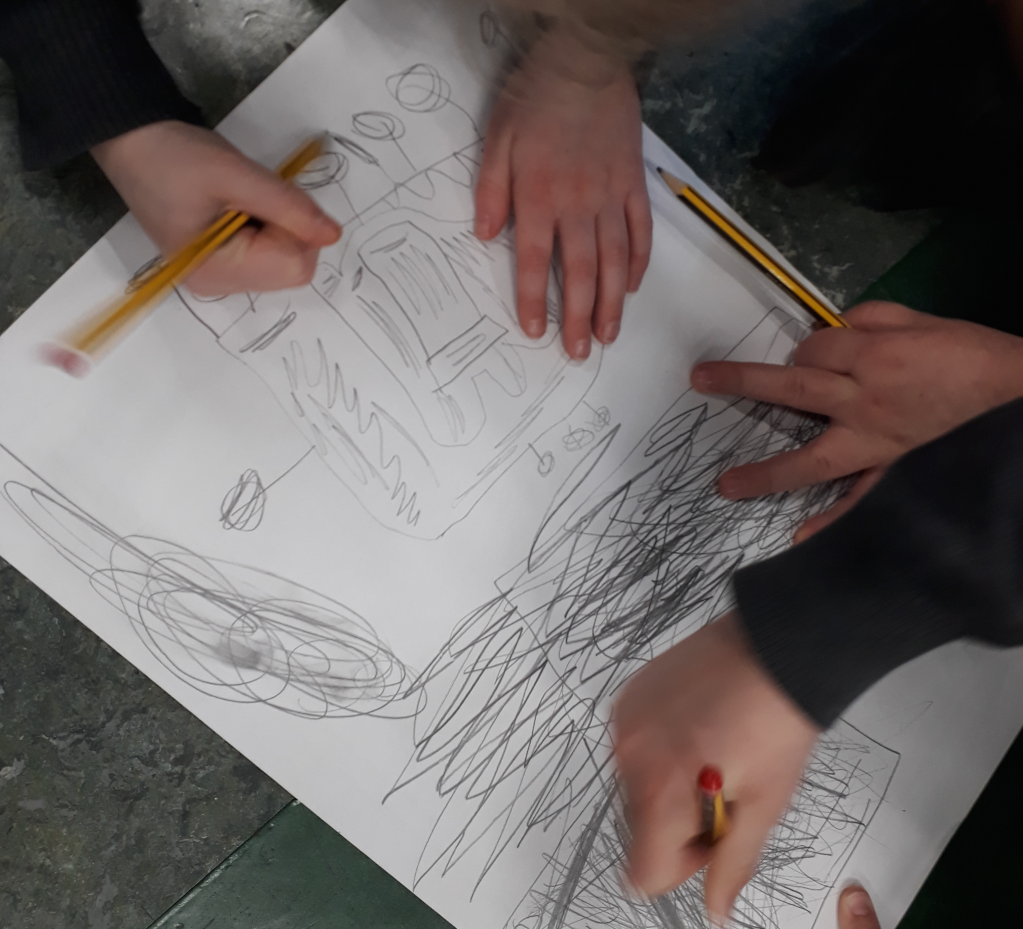
Picasso and Lennon, two of the biggest creative talents of the 20th Century, told us that all children are artists. I am not going to disagree with them. I think we are capable of creating art, but there is a trend I have observed in children and adults alike, in my community practice. Whether we are making maps, retelling tales, meeting new characters, writing lists. Whether they are 8 or 80, a blank page empties the mind. Everyone is full of fears and doubts that block imagination and stamp the message on the inside of their forehead “Art is not for you.”

The thing is because artists are encouraged to access theor inner child and because we have all seen the quote art ‘Every child is an Artist”, which Picasso may have not actually said, we seem to think that children can create something out of nothing.

Children are not creative machines. No one is. It takes time, space, love, inspiration, commitment and play to create. That is all tiring. Sometimes we need to rest, reflect, dream. The truest thing I know as a community artist is that we are all capable of creating with enough encouragement. So what have we all discovered in our creative fervour that has been poured out since lockdown begun in March?

I have found that my expectations on my own children are not what I have for the children I teach. In the early weeks of lockdown. We made rainbows and dragons and mermaids and masks and puppets and pictures. We made them and then they were abandoned. They clutter up the corners of our messy home, gathering dust. I quietly slip them into the bin, a crafty craft post bedtime cull. These outcome based activities passed the time. Sometimes we were really happy to do these tasks and sometimes we made things with my parents over video chat and sometimes we were very cross when we created. I see now that it is forced. I as a maker would find this wearing to never control what I create. I wouldn’t feel proud all the time. I wouldn’t always be interested. If this was my exposure to creating, I would feel very controlled.

Crafting is important. Through doing this we learn how to cut, stick, stitch, sketch, tie, weave. These are important skills for children to have and skills that children don’t get a lot of time to practice once they are in the confines of the National Curriculum. It is vital that children get this practice in. But copying a craft made by someone else is not necessarily a development of our children’s creativity.

So where is the balance? What is the answer? We have to find the mid-ground. We have to provide the opportunity for our children to create. We have to listen to our children and follow their interests. We have to expose our children to ideas. The good news is that ideas are everywhere – games, tv, books, magazines, the natural world. We might have to provide some materials for our children to create with. We then have to let children own their process.

One of the things my youngest daughter loves is her torn paper. We have a box of scrap paper. This box includes old leaflets, envelopes, packaging. If we cut something out of a clean piece of paper we put the cuttings we don’t use into the paper box. But this is not the paper my daughter is interested in. She found some paper from a pastel coloured paper pad. And she tore them up. She stored them in a basket. She places them in little piles on the battered lid of an old gift box. She sorts them very neatly. They’re her cupcakes that she’s made or food for her animals or insects in her garden. It’s annoying at times, to trip or slip over this. It looks a mess. I could dismiss this as rubbish. Tell her to stop tearing up the new paper and use the communal torn paper box. TO STOP LEAVING IT ALL. OVER. THE. HOUSE. If I did this, I would be shutting her off from her creative practice.

The good news is we can all aid children to be creative, but we need to stop expecting creativity to pour out of them. We need to understand that the barriers we have to creativity, are the same barriers that children have. We need to understand that for as long as we focus on products above processes we aiding the shutting down of our children’s creativity. We need to understand that we will never innovate if we are first not inspired to do so.

‘People. Just the idea that the individual is capable of looking after himself, that we don’t need centralized government, that we don’t need father-figures and leaders, that every child is an artist until he’s told he’s not an artist that every person is great until some demagogue makes him less great.’

The actual quote by John Lennon, said in response to what should replace society’s hierarchical model of functioning- Penthouse Magazine, 1969.

If you are someone who sweats at the word ‘creative’ and feels it is a word so utterly other to you, you are allowed to not use that word. Try ‘experiment’ or ‘play’ or ‘investigate’ or ‘build.’ You have all the intuition to lead your child towards creativity, and knowledge will come with practice. If you’re in doubt as to where to begin, go for a walk and let your child lead you.

Categories
Change Creativity Discussions Listening Opinion Story Telling Uncategorized Writing

In the way of a good tale.

This time, more then ever we need stories. Many famous and more intelligent thinkers and writers than me say that after shelter, food and air we need stories. We need stories to listen to and we need stories to tell. But after numerous conversations with friends, peers, fellow artists and family I see a similar trait in behaviour and it’s linked to the way we tell stories.

“We don’t need a list of rights and wrongs, tables of dos and don’ts: we need books, time, and silence. Thou shalt not is soon forgotten, but Once upon a time lasts forever.”

― Philip Pullman

‘I know how lucky I am compared to others…’ is a mantra that is rolled off the tongue repeatedly. I hear it so often, as often as tales begin with “Once upon a time…”. However where “Once upon a time” leads to a story, “I know how lucky I am compared to others” is the completion of a story that hasn’t even been uttered. Now don’t get me wrong, of course we are lucky compared to others and during this difficult time, we need to count our good fortunes and appreciate what we do have. Gratitude is important. Good fortune can keep us healthy and secure. There are plenty of tales of characters losing everything through a lack of appreciation – like this one.

“I know how lucky I am” has become a sneaky silencer of our conflicts and our stories. But it doesn’t need to be. Your stories matter. Hearing the stories of our friends, colleagues and family (the good, the bad and the ugly) will combat the other dominant force in our lives currently – Loneliness. By denying the stories that you need to tell, you are denying your humanity. Many of us would be horrified to find out that we had been silencing the voice of others, and yet we think nothing of silencing ourselves.

I am currently, furiously, painfully trying to tell the story of my great grandparents. They died in the Spanish Flu pandemic of 1918. This has involved a lot of connecting dots through research using ancestry websites and it has been a background project for about 8 months. I have discovered so many wonderful things about them, things that none of us knew. But I have to guess at what they think and feel.

I would have loved to have found letters and diary entries that they had written, I would have loved to have stories told down through time, so much so that the way the stories were told is a story in themselves. But I do not. For many reasons this is not available.

So I want you to imagine, that 100 years from now, your great grandchild is trying to understand how you felt about the time you live in. What would you want them to know? And if you’re not sure where to begin, what questions would you ask your ancestors who lived 100 years ago?

You could write these questions down and you could answer for your time. You could or you could not. Or you could tell your story to the audience that you currently have, the audience who are invested in you now. Your friends, your colleagues, your family.

So instead of using “I know how lucky I am compared with others”, try “Today, I felt…” because we want to, need to hear your stories, even if your voice shakes.

Categories
Change Discussions Exercise Listening Opinion Story Telling

Alterations

I have been thinking over this last month about listening. It goes without saying that if we all want to have greater connection to the world around us, we have to be attentive listeners. I have previously blogged about the things you can do with your body to help you listen more comfortably. I am aware that we all understand that we should be better listeners, but its easy to forget about that when Facebook prompts us with ‘What’s on your mind?’ or Twitter’s decision to double the number of characters late last year.  We are told to tell all,  but are we listening?

Chimamanda Ngozi Adichie talks about the dangers of a single story in her powerful TED talk. We have to challenge that one story we know about a certain person or country.   This  single story limits us and stops us listening. At the extreme, this is what the far-right have always used to justify actions of hate and discrimination. However, at the milder end, we are all missing out on opening our minds to the people and possibilities that surround us.

I am currently reading Keith Johnstone’s ‘Improv for Storytellers’. He writes that instead of telling his students to be ‘Good Listeners’, he encourages them to ‘Be altered by what was said.’ I can’t think of a more apt way for explaining the effect that listening should have on us. So whether we are trying to tune into a conversation in a board room, our children telling us about their day or trying to listen to ourselves with greater integrity, all these moments could lead to alterations about the way we perceive the world. It’s time to let our minds be changed, influenced, informed or moved by what we hear in the world around us.

Categories
Books Discussions Education Feminism Opinion Uncategorized

Reading Challenge

Last November, I finished reading Phillip Pullman’s Book of Dust. Wow, I was swept up in the storms and flooding of Oxford and thrilled with reading about the early days of Lyra, 15 years after first picking up the Amber Spyglass. I was pleased, I had had a good run of books, before Book of Dust, I had read Jonathan Safran Foer’s latest book, Here I am and re read F. Scott Fitzgerald’s The Great Gatsby for the twelfth time.

I thought about the books that I wasn’t reading. The majority of the books I have read have always been written by white, men. Here I was, trying to throw myself into other worlds. Worlds as varied as the last few books I had read and yet I wasn’t challenging myself to read work written by other, not enough. So I decided to challenge myself  to only read books by anyone other than white men. Six months in, I am more excited about reading than I ever had been.  I have time travelled along the Indus, with Alice Albinia and trapped between the pages of Chimamanda Ngozi Adichie’s Purple Hibiscus.  I have been haunted by the language of Nikita Gill’s Wild Embers. I have commuted with short stories and essays from Chinua Achebe, Betty Friedan and Dorothy Parker (Penguin Modern Classics, £1 a book). I uncovered the history of the women and their voices with Mary Beard and am currently lost in 1970’s America with Joan Didion in her collection The White Album. These are just some of my highlights.

20180522_153220.jpg

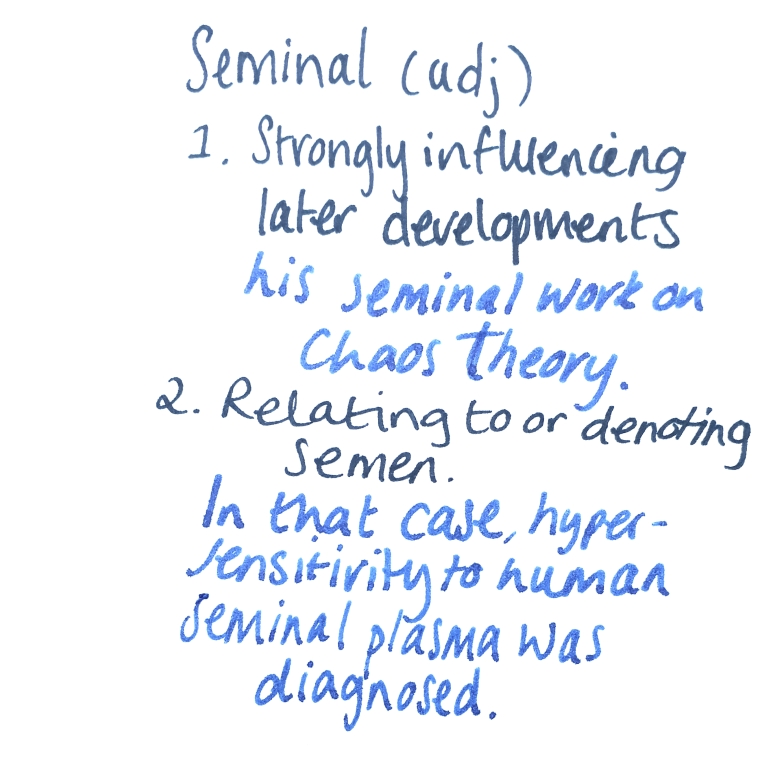
However, I have had to break the rules. Normally when it came to do with work. Storytelling and folklore theory have tripped me up and I have had to read books that where edited, collected or written by white men. Women are present in this scene, but seminal works belong to white men – clue in that adjective.

Generally this challenge has been really fulfilling and exciting and I currently have a shelf full of books that are still waiting to be read. I am always looking for recommendations, what do you suggest?

Categories
Change Creativity Discussions Listening Opinion Story Telling

Why we should all explore traditional tales….

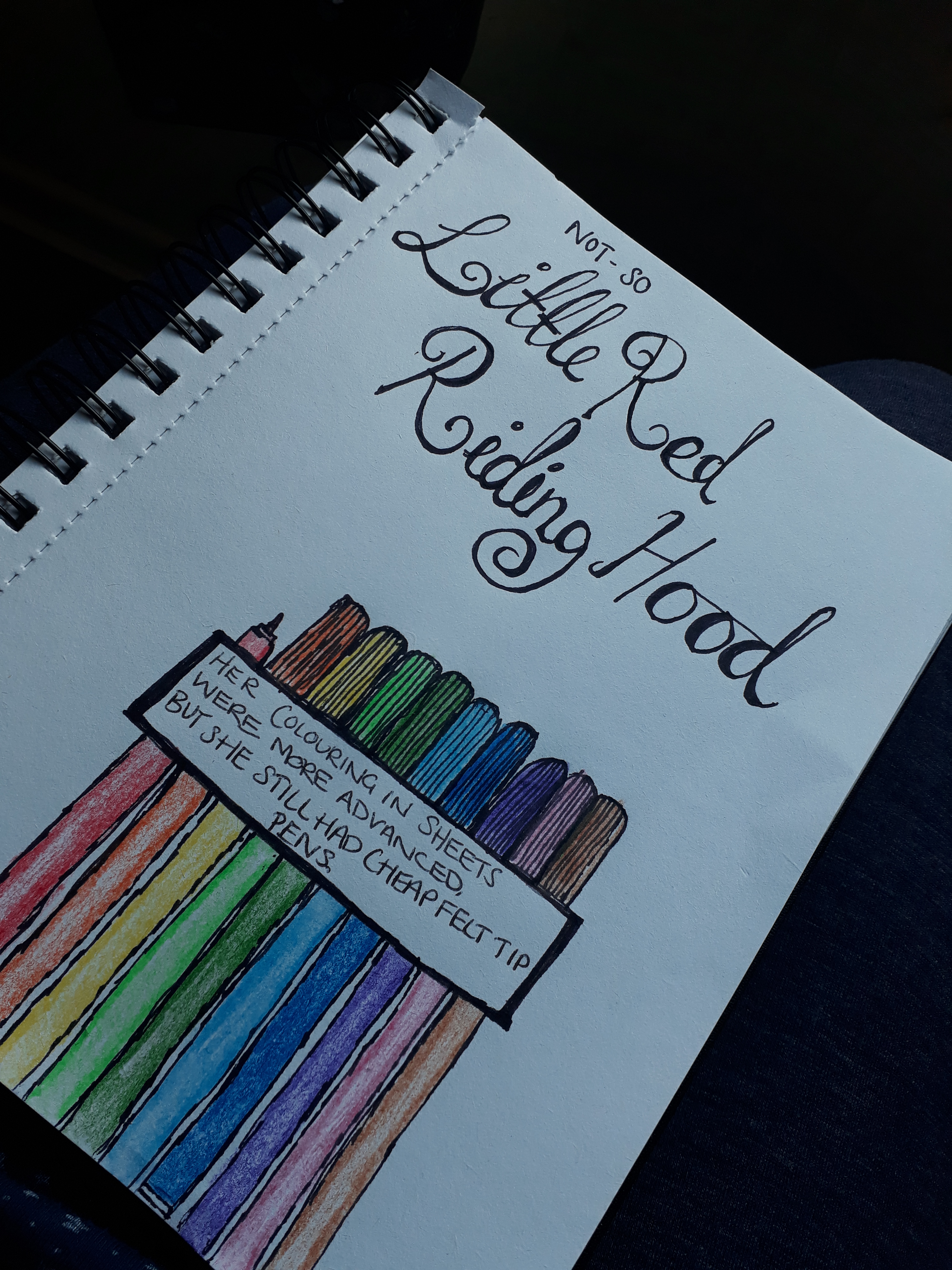
Little Red Riding is a shocking tale. It’s more than the simplified children’s tale of doing what your told (Sticking to the path) and not talking to strangers (the Big, Bad Wolf). We think of all of the Grimm tales and their counterparts as being for children.


20180321_090543
(Not So) Little Red Riding Hood, read on here…

The original name of the Collection was Kinder- und Hausmärchen (Children and Household Tales.) We as modern audience focus on the side of the tales that are for children, but what about the ‘Household’ part of the collection?

When I get asked, as a Storyteller, what content I would perform for adults, I see a lot of nose wrinkling when I say traditional tales like you would find within the collections of Grimm Brother’s, Charles Perrault, Giambattista Basile.

Many of these collectors and writers including Hans Christians Anderson, had not purposely written or recorded their work for audiences made up solely of children. If you read the Juniper Tree from Brother’s Grimm, you are faced with a tale of murder, deceit, cannibalism and children being horribly manipulated alongside a magic tree, a bartering bird, and a little girl. These traditional tales can be (and should be) adjusted to the audience that are listening to them. Often though the tales are heavily diluted into sweet bedtime tales and a patronising delivery of “And the moral of the story is….”

20180221_172733
Marleenken, from The Box collection based on The Juniper Tree

Storytelling is a gateway into literacy (more on this is another blog), if we cheapen the tales in this way, it is no wonder no one can be bothered to sit down and orally share tales. We all love telling anecdotes, we are all storytellers, so why not take these tales and use them as a tool to unpick our modern life.

Cinderella is a tale of slavery. Worldwide, it’s estimated that there are 4.5 million victims of sex trafficking. Beauty and the Beast a tale of imprisoning a young woman. The Beast can be found in the likes of Ariel Castro and Josef Fritzl. The Elves and the shoemaker tells a story if helping those most in need. We need these stories to help us connect into the world we live in.

These stories could be serving as much now, as when they were originally bought into the public consciousness, as they have throughout the whole history of humankind.


Categories
Change Creativity Discussions Feminism Love Letters Uncategorized Writing

Love Letters – #3 Ever Moving Mind

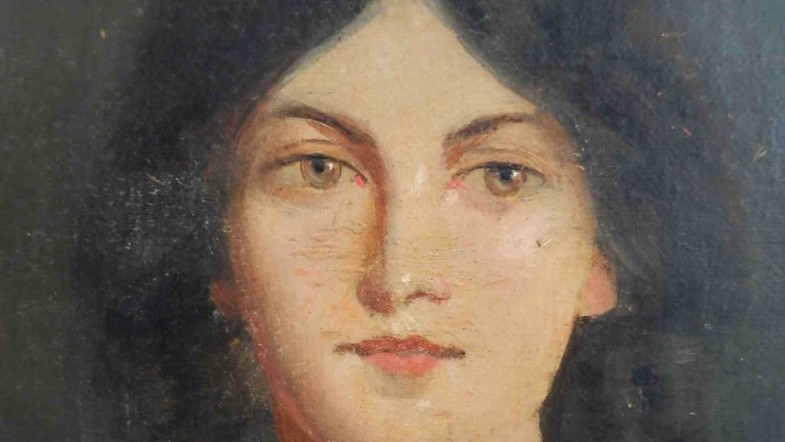
Dear Emily,

I am not Cathy Earnshaw.

I am not Cathy Linton.

Or Isabella Linton.

Yet you are write these characters with such texture that I connect to them. They are not women who are likely heroes, but I still hear the trials and understand them.

This seems important, as you seem like none of these women either, from the short biographies we now have of your life. You write in such an a rich way, that we even connect with Heathcliff.

You come over as someone who had a sense of wonder alongside a sense of home. Who could carve rich imagined worlds from the limits of your bedroom. If we could all write like this or imagine life like this, we would all be able to live freely.

Your poetry also talks of being in the moment. Connecting ourselves into the presence.We have a name for that now – Mindfulness. Linking that to your rich imagination is both inspiring and humbling.

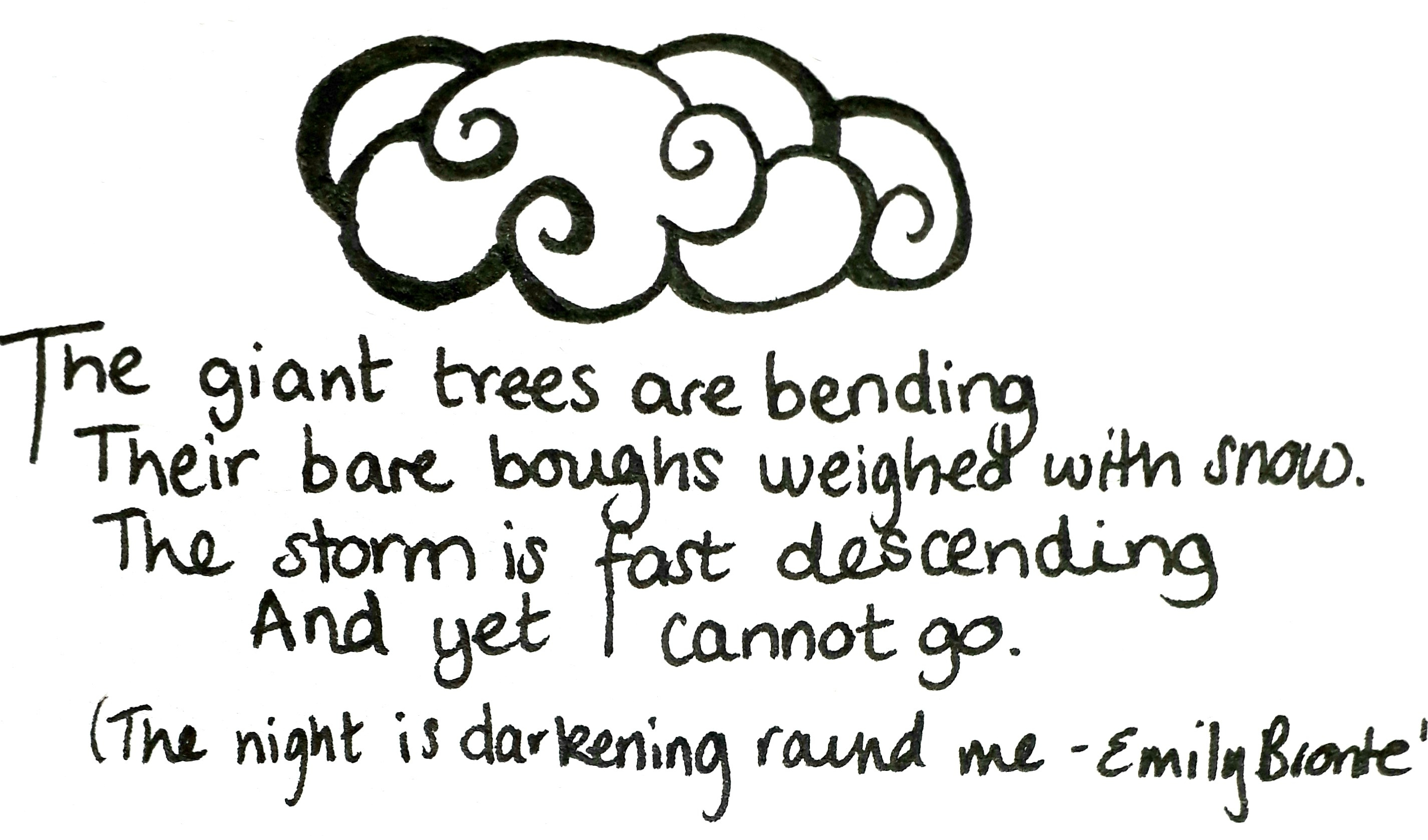
“Thy mind is ever moving
In regions dark to thee;
Recall its useless roving—
Come back and dwell with me.”

Shall Earth No More Inspire Me, Emily Bronte

My mind is ever moving. If I could hang out and chat with you, I am sure that I could become enlightened on this darker regions.

Love,

Felicity

20180307_153720.jpg

Categories
Creativity Discussions Feminism Love Letters Opinion Story Telling Writing

Love Letters – #2 Joyful Leaving

Dear Frida,

You were brave.

And I loved that.

You gave us all you pain

Your doubt

And your uncertainty

In sharing your complex relationship

You had with yourself

And the world around you.

You showed us

That identity is a movable feast.

In this you were not only ahead of your time,

But my time too.


I hate boxes.

I hate labels.

I hate the notion

That we are one thing

Or the other.

You showed us all

That we could be more

Than what the world

Would shape for us.

We could be more

Then what we could

Shape for ourselves.


You lived fiercely

Overcoming pain

And sharing it with us

In vivid paintings.

In your work,

I see that as Artists

We have to be brave

In sharing ourselves

With the world.

We can not simply

Put ink to paper

Without our heart

Pulsating through our hand

And onto the page.


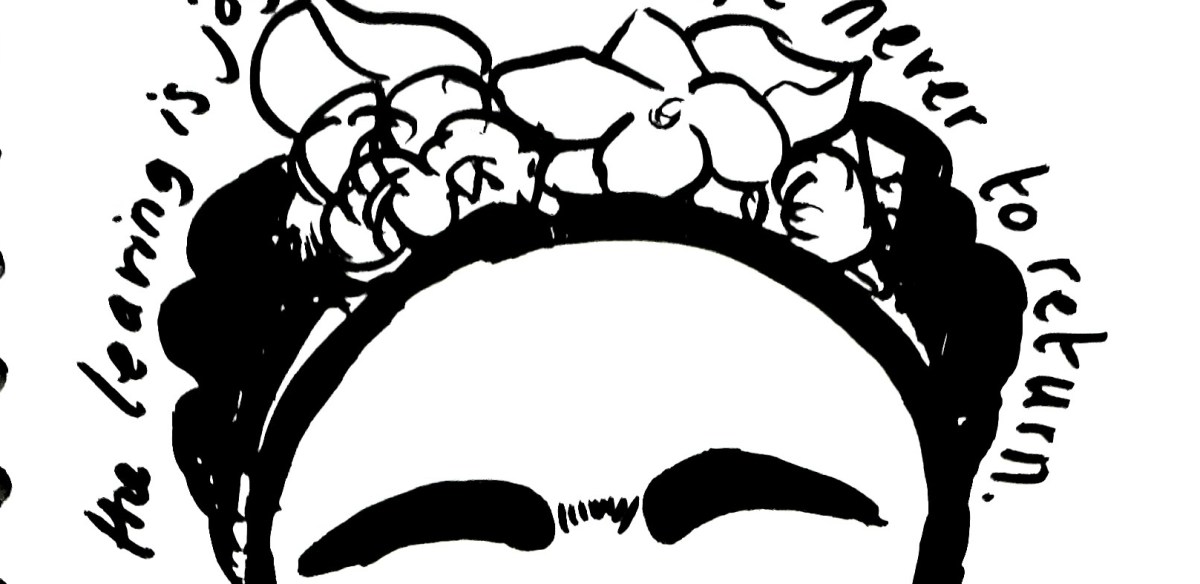
You last diary entry

‘I hope the exit is joyful

And I hope never to return.’

Sings sweetly of a life lived to the full.


All my love,

Felicity.
20180222_143815.jpg

Categories
Creativity Discussions Feminism Love Letters Opinion Story Telling Writing

Love Letters – #1 Still Marching


Dear Suffragettes


Here I am writing

The first of my of Love Letters.

I plan to write a 100.

1 letter for every year

Since the change you

So fiercely fought for began.

1 letter to all 100 women who I love.


You stand out

IMG_20180206_085019_051
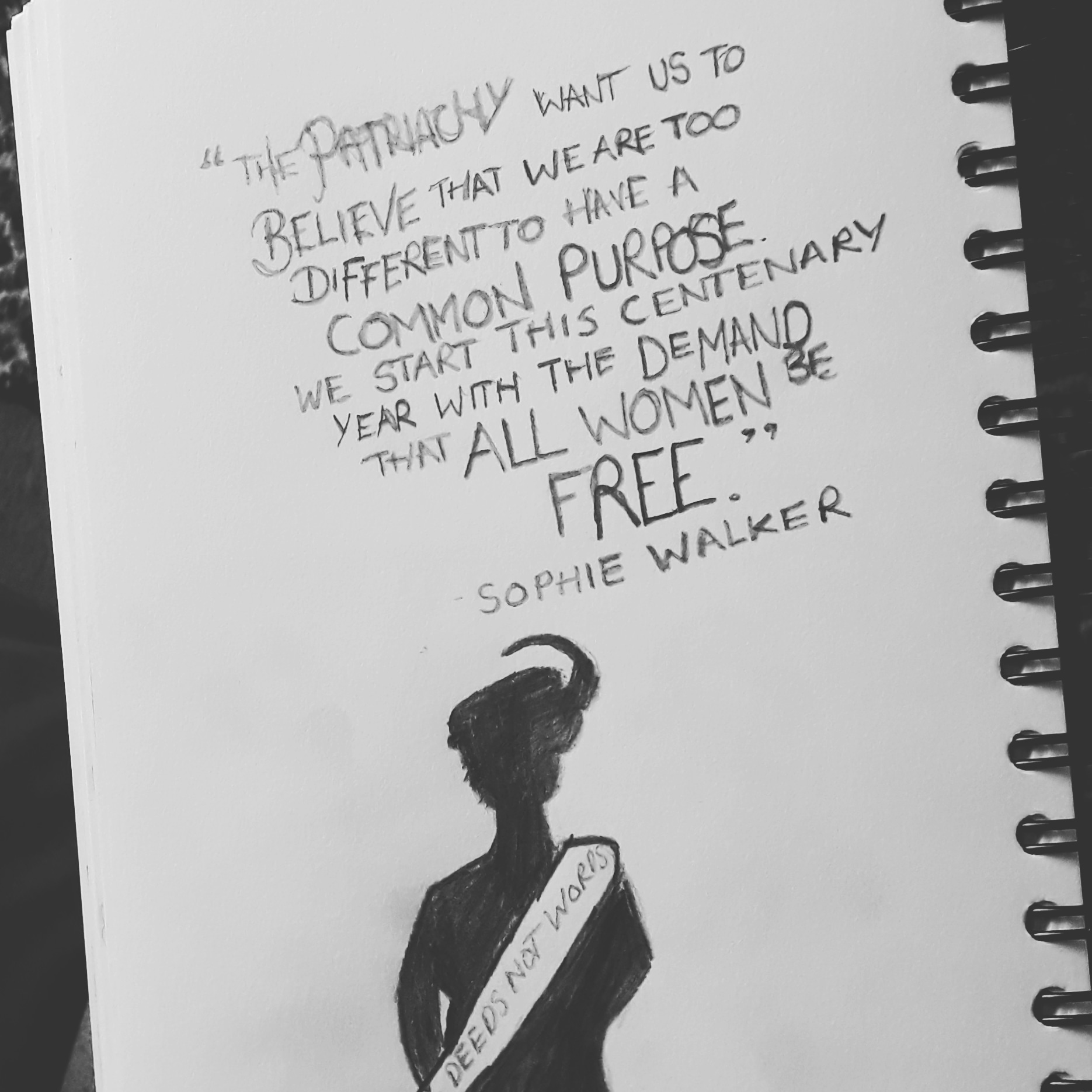
Deeds Not Words

In a crowd of women and men

Who changed the course of history.

You saw that quiet negotiation

Was not working

And you drove social change

With your militant approach.

I am in no doubt

Had you been here

100 years later

Trump would have described you

As a ‘Nasty Woman’.


And you were.

You were unsettling

You discomfort drove others to be uncomfortable.

You were loud and divisive

You were more the floppy hats

We see now in grainy black and white

You were cotton and earth

You were long hours

You were sexually, physically

And emotionally attacked

You were without things

I now so readily take for granted

Rights over my body

Rights over my property

Rights over my children.


You were dismissed as temperamental

You were dismissed as difficult

And I am so thankful

That inspite of this

You ploughed on.

You clogged up the prison service

With your revolution.

When they had enough of the force feeding

When they had realised that prison

did not hold sway over the power

Of your mighty hearts

They took their violence onto the streets

Assaulted in broad daylight at the middle of the road.


How can I honour you?

How can I carry on your fight?

It’s more than voting and petitions.

It’s more than banner waving.

It’s more than marching.

It’s more than online campaigning

It’s living my life to the fullest

Not being held back

By the views of others

The laws support me

Even if some people do not.

I will stand up for fairness

And I will stand up for others

Whose representation is missing

I will hold space, create space

For others.

I will support, share, hold hands

Walk alongside those

Who are not granted the platform

That I do have.


I will not run away

I will not be apathetic

Or indifferent.

I will not be silent.
Love
Felicity

Categories
Change Discussions Opinion Voice

Can we export Christmas to the rest of the year?

There are many things that I love about Christmas and I find that I am a late bloomer of love with it. As the day draws nearer and I look beyond the things I ‘have’ to do (present wrapping, present shopping, more wrapping, food buying, more wrapping, checking lists, checking them twice.), I am reminded of the things I love and surprisingly it’s not the vast amount of food. It got me thinking about how the world might seem a bit brighter if we exported the values of Christmas to other parts of the year.

1. Festive Family Fun

The world just opens open up for things for families to go and do together, big families or small families, young families or older families. From ice skating to crafting to visiting Father Christmas. Most people will be heading to some kind of theatre, whether its a traditional pantomime, or a magical tale or a relaxed romp for the little ones. Theatre’s (both conventional and others) through open their doors and the community descends. Here’s the thing, their are plenty of theatre’s opening their doors the rest of the year for family audiences too. Some of the smaller theatre’s host beautiful and intimate family shows and having the footfall at these places that the traditional christmas show has, could allow these companies to go further in entertaining your family.

2. Singing

City corners become the temporary dwelling of choirs and small groups, people hum along to the brass band, everyone knows the words to Christmas songs, whether its Mariah Carey or Slade. I had a realisation in a singing group for toddlers the other day that I was resisting singing the Bruce Springsteen version of ‘ Santa Claus is coming to town”. If anything makes people feel better its the singing.  We have scientific evidence to support this (http://www.bbc.co.uk/guides/zcc7tyc), you don’t need 3 eggnogs and a baileys to slur your way through Last Christmas at the staff Party. You could join a choir, go to open mic night or head out for Karaoke. Sing with your kids, sing to your Nan, your Brothers, your Dad!

karaoke
How happy does this dog look?!

3. Food

As I said above not the quantity (although that is great too), but all of sudden the most unexpected people are talking in culinary wizardry. They did 3 birds last year, this year their trying 5, their taking notes on Masterchef and Nigella. They have soaked the fruit for the christmas cake from the 27th December last year. the world is full of surprises, but gastronomy at Christmas is perplexing. Your Uncle Brian who doesn’t even know how to scramble an egg, is quoting Heston Blumenthal on making the perfect Persian Spiced Christmas Pudding. I mean, come on Brian, you thought Cumin was something very different in May! However if Uncle Brian rocked out those persian fusion dishes the rest of the year, then I’d be round his house for dinner more. (I don’t actually have an Unlce Brian.)

4. Goodwill

Friendly, helpful and a co operative attitude. Can you IMAGINE?!?!? This would be a completely different country right now if Goodwill was rolled out year round the way it is at Christmas time. We might notice each other more, we might stick up for each other more and we might listen more. This has been complicated by the boom in social media. We now have a soap box in which we can reel off our thoughts, without maybe a backward glance to what we wrote a week later and who we may have hurt in the long run. If we could share our opinions in person, I think we would be more understanding to one and other. We would find a way of working through difference co operatively. Social Media can be a friendly place, and many people are full of Goodwill year round, but if was there in the way it is at Christmas, I’m sure we all wouldn’t be looking at Scandinavia so longingly.

5. Charity

Here is where social media is an incredibly powerful tool. My Facebook newsfeed is filled with folk sharing the work of charities that they are supporting. From Lemn Sissay’s Care Leavers Christmas Dinner to Shelter, from local level charities collecting Christmas Hampers for those without, like Barakah Food Aid to funding campaigns like Bloody Good Period who bring sanitary products to women who can’t access them. It’s brilliant and inspiring to see all these forces of good and people getting behind them. Wouldn’t it be brilliant to see our level of generosity and action rolled out through the rest of the year?

So unlike Wizzard, I’m not wishing for Christmas every day, but I would like the positivity and the great atmosphere that this time of year brings to the forefront.

Although listening to The Darkness, Christmas Time, throughout the year would be great.

Categories
Change Discussions Education Exercise Public Speaking Voice Voice work

In my dream society….

In my dream society, all members have a voice. Everyone has a space to share their opinions, thoughts and feelings. Freedom of speech is the essence of the place I’d like to inhabit. In most ways, this is in place in the world I inhabit. However, the difference between my dream world and reality is that everyone has the ability to understand the power of their voice. Not just in the content, but in the vocal mechanism itself.

Through teaching for the last ten years, it has become apparent to me, that most people think that individuals are gifted with a beautiful speaking voice. A voice that eases into their listener’s ears and transports us with their stories, awakens us with their ideas and moves us with their view. Maybe some people are lucky to have been born with this skill. However I believe that everyone can unleash this marvellous power and use their voice to their full potential, if they are shown how.

In my dream society this is something we would teach to children as part of mainstream schooling, so as adults they contribute to society confidently and freely. In the world we inhabit, children may access this through extra curricular activities. Those who practice the creative and expressive arts are more likely to have confidence in their voice.

As adults in the society we live in, we can feel the divide between those who have accessed this and those who have not. However we perceive it as raw, unlearnable talent. This is it not the case, a clear, confident, authentic voice is available to us all, if we choose to engage with training that explores and deepens our understanding.

In learning these things, we free our voice. In freeing our voice, we share our ideas. In sharing our ideas, we evolve and grow our communities.

My dream society isn’t as unattainable as perhaps it first seems. Maybe yours isn’t either.