Categories
Change children Creativity Discussions Family Listening Opinion SEND song stories Story Telling

Meteorite

Sometimes when you are looking for a story, you can’t find it and yet you can see the need for one everywhere you look.

I have a autistic daughter. The journey to understanding and supporting her has been relentless and remains ongoing. We are lucky she attends a brilliant school with an extremely humble, caring and conscientious SENDCo. Like many families with a SEND child, it has been hard and we have experienced the underfunding that everyone is talking about through a lack of provision of health services and the arms length distance we are held at when it comes to getting practical support and advice.

If you have slipped on the stairs, whilst holding your baby, you body reflexes take over. You pull the baby in close shielding them from the fall with your body as you back takes the bumps, the scratches, the carpet burn and the awful twists. That’s what this feels like. but where the fall is over in seconds, this goes on for years.

I have written this story to share a tiny window into our world. It’s always hard to share personal information about yourself, especially when it comes to your children. 

I hope that it builds better empathy to those who created the complex systems that we have to navigate for our children to have experiences in life that are meaningful and bring joy. 

I hope that it brings comfort and recognition to parents going through similar experiences and I hope that you know, that no matter how lonely or futile things can seem, you and your children matter. I’m going to keep telling myself that anyway.

Help us create an education system that works for everyone:
https://www.change.org/p/reform-the-send-education-in-the-uk

Categories
Change children Creativity Family Grimm Listening Primary stories Story Telling Voice Writing

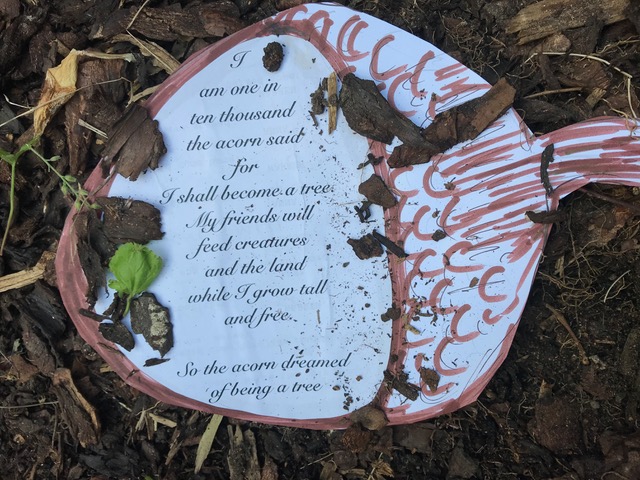
Gretel’s Utopia

If you could build a better world what would it look like?

Gretel wants to live in a better world. She dreams of her perfect place -a Utopia to hope for. This piece of spoken word incorporating song, was inspired by ideas gathered in workshops gather with children and their families over 2022.

A Utopian world building workshop is available to book exploring children’s identity and values and Fantasy and Science Fiction Genres. You can read more about workshops here.

Categories
Change Creativity Discussions Family Listening Story Telling Workshops Writing

The Invisible Women

Peggy Seeger – The Invisible Woman

Watching Peggy Seeger’s singing, I hear the voice of the many older women who I am lucky to have in my life. I have been running creative writing workshops for Davenham Theatre and through Stitch. It really strikes me that the majority of participants are women who are over the age of 55. These workshops are open to anyone to come and yet we see these women loyally attend. They are grateful and positive and tell me that they get so much from the sessions.

But here is something that I think these women would struggle to accept from me. They have amazing insight, they care so deeply about the world they inhabit and their stories are beautifully compelling. It is a gift to spend a couple of hours with these women and listen to their thoughts. I have this amazing tribe that are now my friends.

One of the challenges that many writers face is the fear that anyone will find their work interesting or relevant, it is certainly something I feel at times. However this feeling is rife in this community of women and I think when you listen to Peggy Seeger singing, you can understand why.

Extract of Tell Me A Story of a Chair by Liz, a project by Stitch

My own mum told me that as she has got older, her visibility has dropped. That people pass her by without even seeing her. During the Covid Pandemic, we have all been locked away from each other, unable to meet up in public spaces. Those shielding even more so. We have collectively lost sight of many who are not in our immediate circles. The Invisible turned into memory.

As we emerge from this lockdown and Britain reopens its doors, let’s make sure we have room for everyone at the table. If you are an older woman who is feeling invisible, please tell your story. We need the grandmother’s wisdom now more than ever. If you are not an older woman, pull up a seat and look at ways to ask and listen. Let their stories inspire your story. You’ll feel richer as a result.

Lost Light by Denise for This Is Something That I know a project by Stitch
Categories
Change Discussions Education Listening Opinion Story Telling Writing

The One

Taking down evil in storytelling is quite often presented as an individualistic action. A hero will defeat a villain. These characters are binary. The hero is good and the villain is bad. This narrative has been served up to us time and time and time again. Even when we get told stories about a group of people battling another, this is quite often reduced down to leaders.

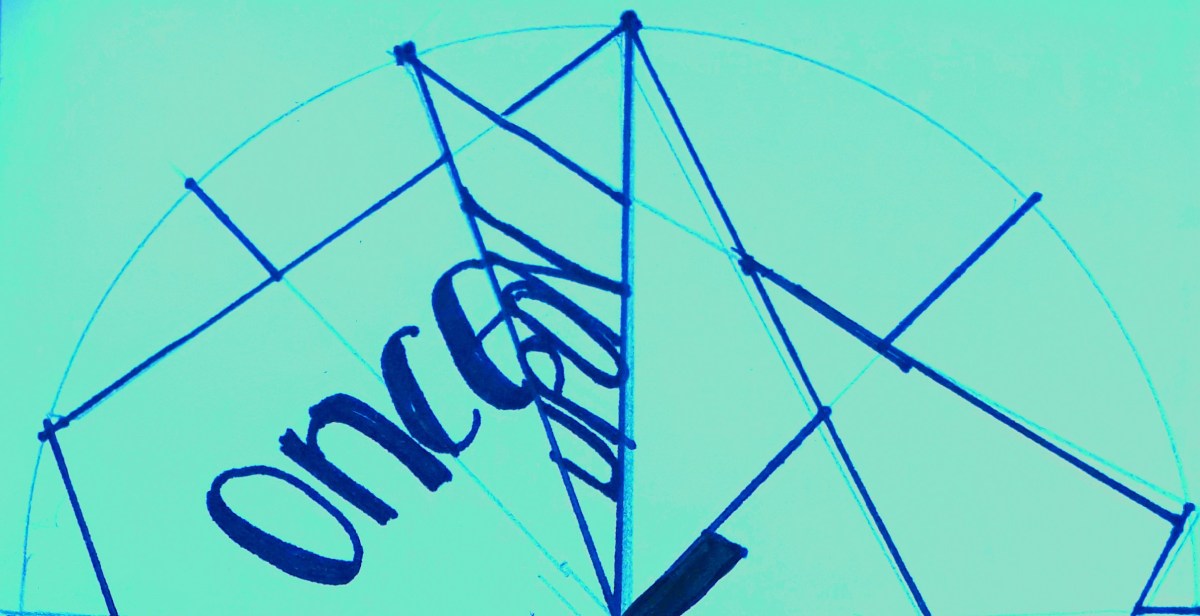
However banishing the monsters of this world is a collective effort. For so long, we have been living in a story of a pyramid. We have been consumed by the notion of the ‘One’.

The one who rules us. The one who stole our heart. The one who cast dark magic. The one that got away with it. The one that saves us. The one that had roast beef. The one that had none.

It is an isolating view of the world and it stops us diversifying what we know, who we know and how we learn. It comes with an enormous pressure. For those that are the one and for those who are not.

When we look at the moments when there was a pivot in society, we would see that those moments are built on ‘We’ and ‘Us’. Not ‘I’ and ‘me.’ The Civil Rights movement, the Suffragettes, School Strike for Climate, Black Lives Matter. These were built by grass root collectives.

Good and just society is neither the thesis of capitalism nor the antithesis of communism, but a socially conscious democracy which reconciles the truths of individualism and collectivism.

Martin Luther King Jnr

So let’s start telling stories where people come together to ask for a better life. Let’s hear stories which aren’t about ‘the one’ but are about ‘Us’. We will discover other ideas and other people and we may even find ourselves sat in their stories in ways that surprise and delight us.

Categories
Change children Creativity Discussions Education Family Listening Opinion stories Story Telling Writing

Music is Music

This afternoon, I entered into a Zoom meeting with composer and musician Tayo Akinbode, hosted by Z-Arts. Being a storyteller, can be a lonely process and we are living in a lonely time, so it was great to hear about how Tayo creates music to tell a story.

One of the thoughts that regularly swills around my head is around the difference and similarities between working with children or adults. It’s a question I get asked regularly moving between these different groups that I work with. It leaves me a bit stumped as other then a slight modification of language, there is no difference. Children laugh and so do adults. Adults struggle crossing the creative threshold and so do children. Both children and adults want to hear and tell stories. So it is a relief to hear someone as experienced as Tayo say ‘I wouldn’t dumb down music for children.’

I have finished writing the story of my family ancestors. A project I was inspired to start after working with Emily O’Shea company, On The Border. I am now in the process of editing the story into an audio experience and it is a relief to be piecing the story together. The writing process has been difficult. The vision I sat down with was to create a piece of audio storytelling about my great-grandparents. They were performers at the turn on the 20th century who went on to manage some of the first variety cinema’s in the country (a mixture between Music Hall and Cinema). Before I sat down to research, this part of my family had mythical qualities. I wanted to use Music Hall numbers in order to help tell their story. I wanted this to be a piece for family audiences. Something that could be enjoyed with everyone – an intergenerational activity. That you could listen at a distance together with your elderly granny who is shielding and your 8 year old nephew who is home schooling. That it would open up conversations about family stories in a way that I could not have with my own grandparents. I was going to use this idea to develop my creative practice, to experiment and play.

But the doubts creep in. Will children get this? Is the music too bawdy? Am I just inventing truths that I cannot find? Is this material appropriate for family audiences? Nothing kills playtime like doubt and nothing makes experimentation more pointless then isolation. So thanks to Z-Arts for providing connection and thanks to Tayo for grounding me and reminding me that children are no different from the rest of us, which in my wobbly, lonely, creative moments I forget.

Solsbury Hill

I grew up in Reading and we had family down in Bath. When we drove down to see them in Bath, my Dad would play Peter Gabriel’s albums. We loved the track, Solsbury Hill. We used to drive past Solsbury Hill on the route to see our family. We used to climb up it (when you could). We loved that song. We’d ask for more Peter Gabriel. We’d listen Red Rain, Don’t Give Up and Games without Frontiers. We did not hear the loaded political meaning in these songs. We didn’t here the meanings that I as an adult now hear. Tayo told us today ‘Children like Music.’ Its a simple statement, but it is an easy one to make. No matter how much I see my children request Michael Jackson (their Dad’s favourite) or sing along to Fleetwood Mac (Rumours is my go to Album), in my artistic process my lived knowledge gets crowded out by my doubts over how to execute an idea. I managed to create children into something ‘other.’

That is why I love working creatively with children. They remind me that we are all not that different from each other. I’m looking forward to Z- Arts opening their doors again so I can be reminded of this by the real child experts, the children themselves. Until then, I will keep going. Clumsily put one foot in front of the other.

After all music is music to be made, all stories are stories waiting to be told and all humans are humans waiting to be heard, no matter their size.

This project am I am working on has bee made possible by funding from the Arts Council Emergency Response Fund. The funding has allowed me time to develop my skills, conduct research and connect to other artists. My thanks go to Z-Arts for providing free access to these conversations and understanding that these conversations are needed.

Categories
Change Creativity Discussions Listening Opinion Story Telling Uncategorized Writing

In the way of a good tale.

This time, more then ever we need stories. Many famous and more intelligent thinkers and writers than me say that after shelter, food and air we need stories. We need stories to listen to and we need stories to tell. But after numerous conversations with friends, peers, fellow artists and family I see a similar trait in behaviour and it’s linked to the way we tell stories.

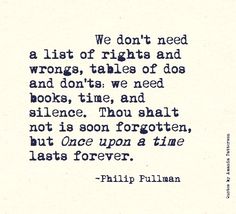
“We don’t need a list of rights and wrongs, tables of dos and don’ts: we need books, time, and silence. Thou shalt not is soon forgotten, but Once upon a time lasts forever.”

― Philip Pullman

‘I know how lucky I am compared to others…’ is a mantra that is rolled off the tongue repeatedly. I hear it so often, as often as tales begin with “Once upon a time…”. However where “Once upon a time” leads to a story, “I know how lucky I am compared to others” is the completion of a story that hasn’t even been uttered. Now don’t get me wrong, of course we are lucky compared to others and during this difficult time, we need to count our good fortunes and appreciate what we do have. Gratitude is important. Good fortune can keep us healthy and secure. There are plenty of tales of characters losing everything through a lack of appreciation – like this one.

“I know how lucky I am” has become a sneaky silencer of our conflicts and our stories. But it doesn’t need to be. Your stories matter. Hearing the stories of our friends, colleagues and family (the good, the bad and the ugly) will combat the other dominant force in our lives currently – Loneliness. By denying the stories that you need to tell, you are denying your humanity. Many of us would be horrified to find out that we had been silencing the voice of others, and yet we think nothing of silencing ourselves.

I am currently, furiously, painfully trying to tell the story of my great grandparents. They died in the Spanish Flu pandemic of 1918. This has involved a lot of connecting dots through research using ancestry websites and it has been a background project for about 8 months. I have discovered so many wonderful things about them, things that none of us knew. But I have to guess at what they think and feel.

I would have loved to have found letters and diary entries that they had written, I would have loved to have stories told down through time, so much so that the way the stories were told is a story in themselves. But I do not. For many reasons this is not available.

So I want you to imagine, that 100 years from now, your great grandchild is trying to understand how you felt about the time you live in. What would you want them to know? And if you’re not sure where to begin, what questions would you ask your ancestors who lived 100 years ago?

You could write these questions down and you could answer for your time. You could or you could not. Or you could tell your story to the audience that you currently have, the audience who are invested in you now. Your friends, your colleagues, your family.

So instead of using “I know how lucky I am compared with others”, try “Today, I felt…” because we want to, need to hear your stories, even if your voice shakes.

Categories
Change Discussions Exercise Listening Opinion Story Telling

Alterations

I have been thinking over this last month about listening. It goes without saying that if we all want to have greater connection to the world around us, we have to be attentive listeners. I have previously blogged about the things you can do with your body to help you listen more comfortably. I am aware that we all understand that we should be better listeners, but its easy to forget about that when Facebook prompts us with ‘What’s on your mind?’ or Twitter’s decision to double the number of characters late last year.  We are told to tell all,  but are we listening?

Chimamanda Ngozi Adichie talks about the dangers of a single story in her powerful TED talk. We have to challenge that one story we know about a certain person or country.   This  single story limits us and stops us listening. At the extreme, this is what the far-right have always used to justify actions of hate and discrimination. However, at the milder end, we are all missing out on opening our minds to the people and possibilities that surround us.

I am currently reading Keith Johnstone’s ‘Improv for Storytellers’. He writes that instead of telling his students to be ‘Good Listeners’, he encourages them to ‘Be altered by what was said.’ I can’t think of a more apt way for explaining the effect that listening should have on us. So whether we are trying to tune into a conversation in a board room, our children telling us about their day or trying to listen to ourselves with greater integrity, all these moments could lead to alterations about the way we perceive the world. It’s time to let our minds be changed, influenced, informed or moved by what we hear in the world around us.

Categories
Change Creativity Discussions Listening Opinion Story Telling

Why we should all explore traditional tales….

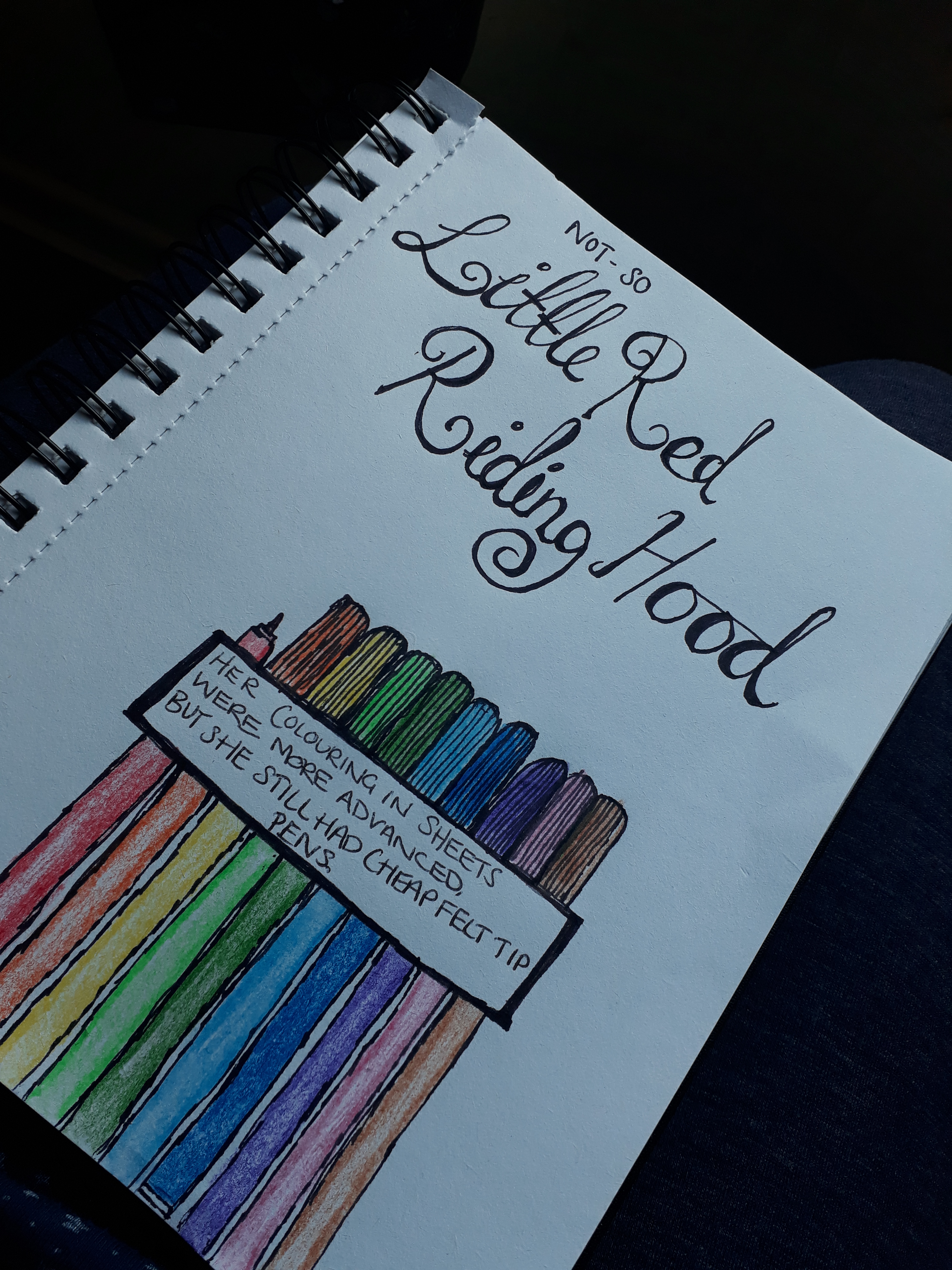
Little Red Riding is a shocking tale. It’s more than the simplified children’s tale of doing what your told (Sticking to the path) and not talking to strangers (the Big, Bad Wolf). We think of all of the Grimm tales and their counterparts as being for children.


20180321_090543
(Not So) Little Red Riding Hood, read on here…

The original name of the Collection was Kinder- und Hausmärchen (Children and Household Tales.) We as modern audience focus on the side of the tales that are for children, but what about the ‘Household’ part of the collection?

When I get asked, as a Storyteller, what content I would perform for adults, I see a lot of nose wrinkling when I say traditional tales like you would find within the collections of Grimm Brother’s, Charles Perrault, Giambattista Basile.

Many of these collectors and writers including Hans Christians Anderson, had not purposely written or recorded their work for audiences made up solely of children. If you read the Juniper Tree from Brother’s Grimm, you are faced with a tale of murder, deceit, cannibalism and children being horribly manipulated alongside a magic tree, a bartering bird, and a little girl. These traditional tales can be (and should be) adjusted to the audience that are listening to them. Often though the tales are heavily diluted into sweet bedtime tales and a patronising delivery of “And the moral of the story is….”

20180221_172733
Marleenken, from The Box collection based on The Juniper Tree

Storytelling is a gateway into literacy (more on this is another blog), if we cheapen the tales in this way, it is no wonder no one can be bothered to sit down and orally share tales. We all love telling anecdotes, we are all storytellers, so why not take these tales and use them as a tool to unpick our modern life.

Cinderella is a tale of slavery. Worldwide, it’s estimated that there are 4.5 million victims of sex trafficking. Beauty and the Beast a tale of imprisoning a young woman. The Beast can be found in the likes of Ariel Castro and Josef Fritzl. The Elves and the shoemaker tells a story if helping those most in need. We need these stories to help us connect into the world we live in.

These stories could be serving as much now, as when they were originally bought into the public consciousness, as they have throughout the whole history of humankind.


Categories
Change Creativity Education Listening Opinion Story Telling Voice

Once upon a time lasts forever

0562333a751cc59a1b96f3fb8d282114-reading-quotes-reading-books


I stumbled across the above quote, and it resonates incredibly powerfully. Early on this summer I completed a course called The Performer’s Playground with ClownLab. It was a 12 week exploration of playfulness. We had a lot of conversation about finding the joy or the fun in something and enjoying being beautiful even if we were playing something ugly. How do we create fun or channel playfulness?

On reflection, I think the things that inhibit me are the parameters that I  have either set myself or the the ones that I have allowed others to set for me – ‘the table of do’s and don’ts‘ as Pullman calls it. There are a list of things I can do and a list of things I can’t do. I wrote a while back about Growth Mindset, the idea that through a shift in personal attitude can alter our potential. How do we know that our personal attitude needs to shift? How do we believe that our potential is unlimited?

Neil Gaiman wrote in Coraline “Fairy tales are more then true; Not because they tell us the Dragons exist, but because they tell us that Dragons can be beaten”.

22dcff855e9d55c56c9425e0e8c8fea1
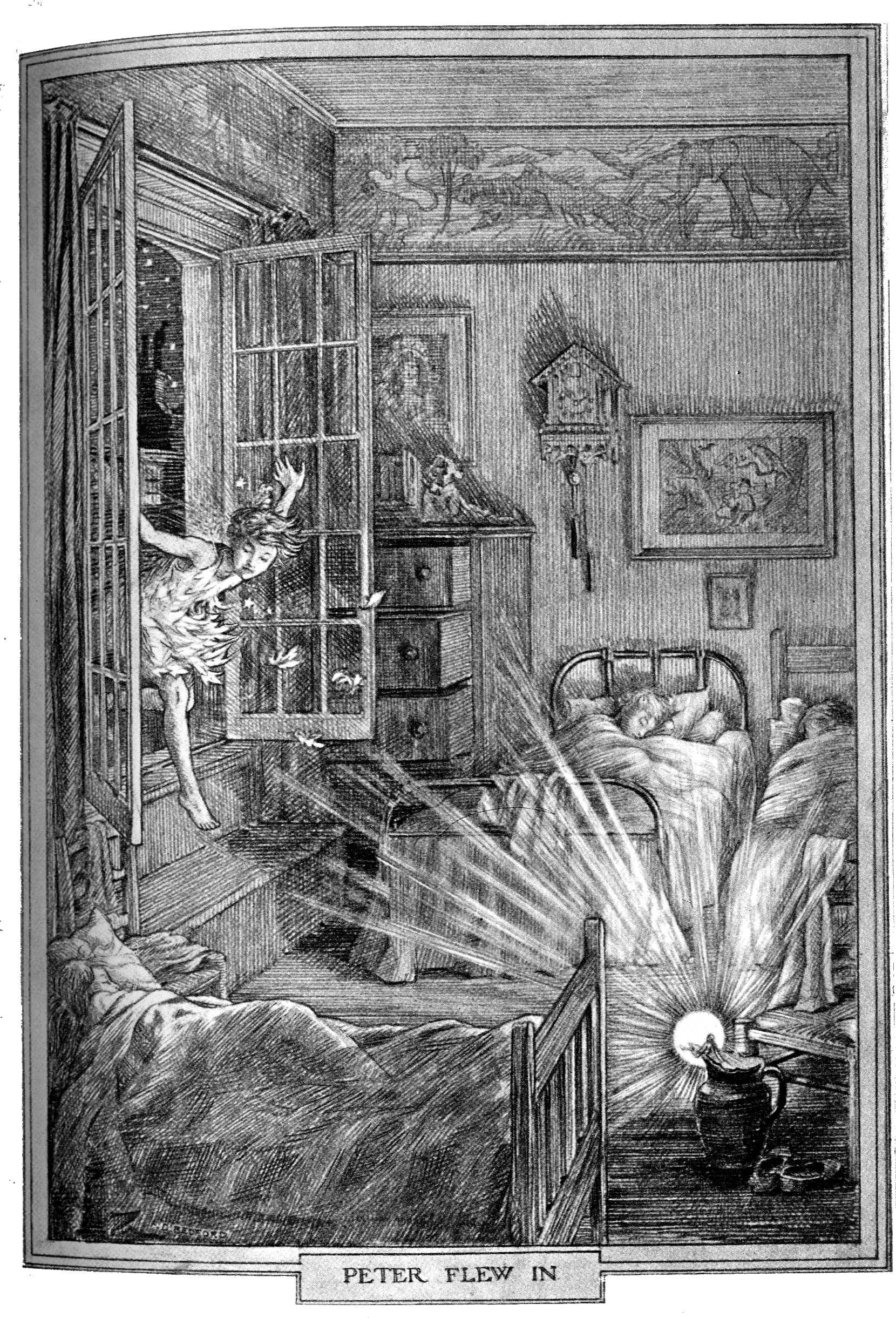
illustrations by F. D. Bedford  J.M. Barrie’s Peter & Wendy

Stories allow us to see that we can do, or be anything. Some of our favourite characters in our most loved tales and stories have the hardest start; they are orphans. Harry Potter to Cinderella; Superman to Peter Pan; Mowgli to Sophie in the BFG. Their world has been disrupted in a way that no one would want for a child.  Yet, these characters go on amazing adventures, and overcome huge obstacles and show a resourcefulness and resilience to find their way through. Peter Pan has no ‘list of right or wrongs’ just a love of play and make believe. His game playing allows him survive and outwit his enemies.

The art of oral storytelling transcends age, ethnicity, education, borders and gender whilst also recording and reflecting our difference in those things. This kind of storytelling is a shared act between teller and listener. Jane B. Wilson tells us in her book The Story Experience, “Those who tell tales are both speakers and listeners. They have heard and remember”.

We are all storytellers and we are all listeners, if we allow ourselves the possibility to listen. We can all believe that we can do more, be more then we think we are. If we see others have defeated the bad guys, maybe we can too.

“The listener is caught and whirled into a talk, living for a single moment in the good, the great, the naughty, the lost. The tellers voice awakes dreams and spins stuff for thought; incites to contemplation.”

The Story Experience, Jane B. Wilson


Categories
Creativity Discussions Listening Opinion

Sound

54eb698451151_-_9-things-you-didn-t-know-about-your-ears-mdn

Sound is a wonderful thing. It fills me up, takes me away, gets my body moving and connects me to others. The spoken voice has the same effect and I love the act of sharing sound. It could stories about your Granny, songs for you children, sounds as you try to loosen your voice and set it free. It could be the first dance at your wedding, the way that you mother said your name when you were caught doing something you shouldn’t or the way that a whole room will start dancing to Whigfield’s Saturday Night.

It could be on the words from your midwife saying ‘it’s a girl!’ or the sound your child makes when saying hello, like a sample it sticks in your head on loop. Sound can be the turn of the key in a lock, in an egnition, in a front door. It could be the smashing of glass, the churning of the washing machine. It could be sssshhs and aaaahhss and ohs and ows and wows. Sound whether I hear it or make it, I feel its vibrations deep in my stomach warming up my body and trickling through me like an outstanding chocolate soufflé.

Sound can swamp us, divide us and conquer us. It can leave us alone and aching for noise to filter through our ears. It can build us up, reach out to love ones and strangers and alert others to dangers. It can be comfort. The sound of the oven timer, bread being lifted out of the oven and turned out onto a cooling rack.

Sound can be the voice of someone telling others what is right and wrong, who is right or wrong or where is right is wrong. Sound can be the sound of water lapping on the side of a rubber dingy as you make your way to a new life. Sound can be the shuffle of papers as you wait nervously for someone to tell you you are allowed to stay. It can be the call to arms, the call to hate, the call of love and propaganda and bird song and waterfalls and the purr of you cat. It can be the slam on your brakes, letting that pheasant quickly escape. Sound can be, can be, can be….

difference-between-sound-waves-and-electromagnetic-waves-image-1

The sounds we make and hear have specific memories attached to them. Some of my clients and quite often surprised by the emotional challenges that voice work brings to the surface. I’m not a counsellor, but I am a willing listener and an open ear. I have to be to be a good teacher. Whether you come in the door, looking for accent reduction, better breath support or increased authenticity in the way you speak, a safe and open environment will greet you. Something which is vital for the vulnerability that is often exposed in the lessons.

Today is a new day and we don’t know what sounds await in the future. If you write, keep writing. If you sing, keep singing. Keep dancing, creating and sharing. It can feel so unbelievably futile but it is where we can be vulnerable and share our thoughts. Keep practicing vulnerability and trust that the sounds that come with that as just as valuable and beautiful as anything else.

Felicity is a Voice Teacher, Playologist and Story Teller based in South Manchester, UK. To find out more about her work, please visit http://www.felicitygoodman.co.uk